Ugh. These sort of pseudo-intellectual articles that mix economics and politics are my least favorite things to see on this site. They are super misleading and play towards people's biases about how they view the world while selectively interpreting the sparse data they present to do so.
An example:
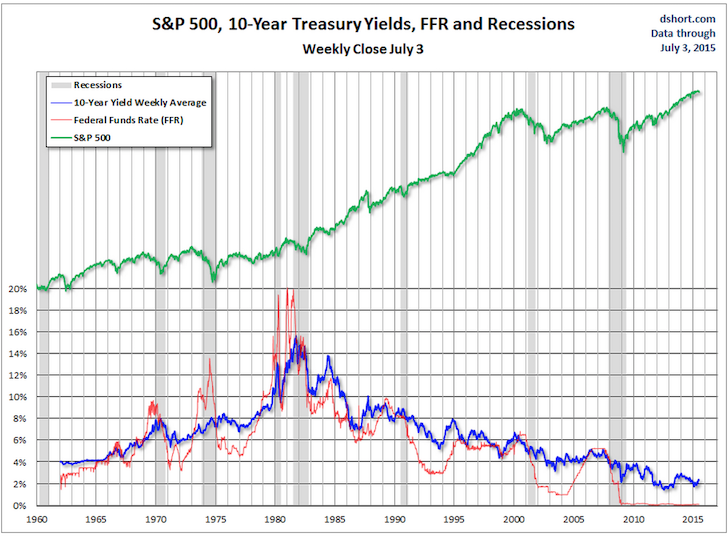
If there was too much money, you would think that bond yields would go down. Look here: https://www.cnbc.com/quotes/?symbol=US30Y -- looks like they are! Guess we can all go blame the fed and "trickle down". But oh wait, scroll out to a longer time-span. Looks like yields have been falling ~linearly from 1989 till today, 2019. Show me where QE/ZIRP started based on the chart. You can't, because the trend didn't change at 2008/9. All this "blame the fed, im smarter than them and would've not done QE" nonsense maybe isn't as supported by evidence as some would like. The world is a little more nuanced than that.
On the surface level, the data seems to agree, but you look a little deeper and it quickly becomes apparent it's all bullshit trying to spin a narrative.
At which point these charts become entirely meaningless? When the fed owns 50%+ of sp500?
The fed, BOJ and ECB are already busy painting yield curves full time, the market has become so distorted it's not trivial to even orient yourself, nevermind to develop conclusions.
I've wondered if, in this context that we are in, it actually starts to make sense to both raise interest rates and simultaneously monetize government debt.
We want some inflation, but we also do not want a late-1980s-style Japanese asset price bubble.
I cannot find a real answer to this question anywhere - would this plan produce any negative effect? The plan would, as far as I can tell, help the long-term outlook of our currency and economy while incentivizing wealthy people to stay invested.
I might be missing something obvious. Maybe this would lead to businesses having a harder time employing because of the higher borrowing cost (but we are at full employment now), or maybe the effect is just too uncertain on the money supply. Either way, I really want to know the answer, so I'm asking it here.
To be clear, I am not suggesting that politicians have direct control over monetizing debt, but rather that the central bank deems this to be best for the economy in the long term.
The Fed's quantitative easing program pushed the cost of borrowing money to next to nothing for nearly a decade, allowing companies to splurge on debt for mergers and acquisitions and to boost revenue."
Put another way, the Fed made the rich richer, and the lack of significant "trickle down" has created a socio-political Charlie Foxtrot; of which the Fed is not accountable for.
It’s trickled down but in narrow bands. For example, starting salaries in the Bay Area are up big in the last decade, partly because of an influx of easy money into tech growth tech companies.
However, much of that goes directly into the pockets of land owners.
Ultimately the winners in QE are those that own the finite resources.
That's not the issue. The issue is the Fed tilted the game in the favor those already winning the game. And as a friendly reminder, no one elected the Fed.
I don't want to get off-topic but the birth rate is an unspoken reason why we have 12+ million "undocumented workers". Immigration is proxy for population growth, which in turn is an easy way to "grow" the economy.
Obviously, propping up the economy in that way has helped to spark socio-political issues. Long to short, the Fed is "against" the middle class and immigrants are taking the brunt of the blame for it.
Personally, I grew up in a rural area in NY that is basically being systematically wiped away, because of these policy decisions made in a vacuum that few people understand.
People blame "the other" and get caught up in racist nonsense. Meanwhile, we're reverting into ancient latifundia and turning into a society where basic human needs aren't being met.
Another FYI - In Europe (e.g., Germany and France) a similar thing has happened. The difference there is a noticeable percentage of the immigrants are Muslim (and are generally less inclinced to assimilate). I remember reading a couple of years ago that soon enough (read: 25 to 50 years?) - if current trends continue - Muslims will be the majority in Germany. So while Germ's economy has fared well as of late, it might be sitting on a cultural powder-keg if the economy stagnates.
As for Japan's economic stagnation of the last couple decades? Relatively low immigration.
Precisely why I’m a big fan of tariffs and America-first foreign policy.
We need a way to restore manufacturing industry to the US, the loss of which played a large role in the erosion of the middle class. Protecting manufacturing and factory jobs used to be a selling point for Democrats but things have been a little turned upside down lately.
This is just incorrect. A 25% tariff doesn't correct for the difference in labor costs between China and the USA, because the difference in labor costs is > 25%. It just makes stuff more expensive for Americans.
It is more difficult to evade tariffs or VAT on imports, sure. For that to even out the playing field, it would have to be refunded to average Americans, and I am not sure it can even happen given the fiscal structure in the US?
Maybe a patchwork of all sorts of federal programs, better Medicare here, some more govt jobs there, etc? A direct refund would probably work much better.
There's something wrong with the data at that URL - the data, not the web site which is really attractive and responsive.
The first two states checked out were funky. That there are $659M of wireless phone exports from Calif to China doesn't pass the smell test. It's an incredible claim requiring incredible proof but there's nothing there despite the state being colored in as suffering Extremely Significant Damage. Another state, Florida, gets off more easily and only suffers Very Significant Damage. Drilling down it turns out the goods being tariffed aren't good at all: The tariffed items are literally scrap gold jewelry and scrap metals.
California's stealthy cellphone export I'm pretty sure don't exist. I'd argue that Florida's scrap exports are resources better kept in country as feedstock to help spur on-shore manufacturing.
I'm going out on a limb and expect the remaining 48 states are showing tariffs on bulk minerals, ag products, trash, and make-believe products. Tariffs on these items are positives insofar as they keep input costs low for domestic producers.
I realize that tariffs are controversial given the current political climate, but they really are one of the best ways to claw back money from large corporations and reward unskilled labor in the US. We need to bring manufacturing jobs back to the US.
The loss of those jobs disproportionately affected minorities. Increases in corporate tax is easily avoided by domicile changes. Tariffs are a simple way to restore balance. Build it here. Hire here. No tariffs.
Do you have evidence to support your claim? I ask because in my experience this is one of those "sure, makes sense" situations (like "just build a wall!") that, when actually taken in the context of real world economics, doesn't work.
Perhaps. But also keep in mind that in bringing back that manufacturing we'll be bringing back the ecological issues (read: pollution) as well. There's always an unintended consequence or two.
The "trickle down" story keeps coming up, but it's untrue. It simply doesn't work that way.
If someone who is already rich gets even more, it won't be spent in a way that is good for someone poor. More likely, the excess money will be invested in a way that provides yield, like buying real estate, driving up prices and rent. Or merging businesses to lower competition and costs. Leading to money streming 'up' instead of trickling down.
The trickle down story is a hoax that needs to die.
It 'keeps coming up' because it's a strawman people love to punch. People literally only bring up this concept in order to tear it down - because it was only created in order to be torn down.
Nobody actually argues for 'trickle-down' policies. It's a sneer term signifying a deliberately oversimplified version of right-wing economic policies. It's not a real position people hold and push for.
I guess it's a lot easier and more fun to feel righteous attacking strawmen than it is to do the work of interacting with real ideas with serious intellectual backing and real influence.
Corporations and rich people fight for lower taxes all the time. Usually the argument is that if the taxes are too high they will just move to a different country.
The Fed is against raising the minimum wage because it will make inflation increase above the allowed 2% per year. Which kind of makes sense because paying workers more will make things more expensive especially service businesses. But, they should still raise the minimum since most service businesses are heading for automation and the bump will help workers have a better job transition.
The US Fed's inflation target is symmetric about 2%, though it has almost consistently undershot it in recent years.
Some argue that higher inflation is less scary than deflation because "interest rates can always go higher", but I would agree the Fed does seem to be more worried about upside inflation risks. Possibly because monetary policy has been "accommodative" (in their view) for so long, and "normalisation" has been a clear long-run goal. There are signs those tendencies have changed, though -- they've been talking about being "data driven" since last year, and recent messaging has smoothed the road to possible rate cuts too.
To the best of my knowledge, the Federal Reserve has no official position in favor of or against raising the minimum wage. Claiming otherwise is speculation and likely misinforming people.
Disclosure: Former researcher at the Federal Reserve Board
Could you elaborate how the timing of a minimum wage hike now could help with the adjustment to the arrival of automation related job loss? Note: No snark on my part, it seems plausible and I'm generally looking to be able to debate the topic more intelligently.
Many service workers work 2 jobs to make ends meet. If they start earning enough from one job, that's extra time and money that can go towards a certification. I know Amazon has offered many of it's workers $10,000 to quit and start a delivery company. They are trying to help them transition as bots are taking warehouse jobs.
It could boost per worker automation, but there will be fewer workers, and less economic output to reinvest into capital (which is essentially automation), so there will be less automation in general.
So higher automation per worker but lower automation per capita.
Capital isn't "essentially automation" in general. It includes a lot of other things like land and art and government bonds.
If you have a job which can be automated at a cost equivalent to a $10/hour wage, it doesn't get automated when the wage is $9 and does when it's $11. The money doesn't inherently come at the cost of some other automation, it may (and if the other automation is profitable, more likely does) come from selling some bonds or other assets you own, or by borrowing it from a bank which just creates the new money from nothing as banks do.
You're also ignoring a number of other effects like the higher demand for automation allowing fixed costs to be spread over more units and lowering the purchase price of the automation equipment.
A lot of these things are actually good -- if people sell real estate to buy automation equipment then housing prices come down. If four people get replaced by four machines and one person to look after them, the person who knows how to look after the machines may get paid more than any of them would have before the automation.
But the other three are still out of a job, and are then in a wasteful competitive signaling game with all the other newly unemployed to overpay for degrees and credentials because none of them are allowed to compete by accepting lower compensation anymore.
I'm referring to 'capital' in the economic sense, not financial sense.
Here's the Wikipedia definition:
>>In economics, capital consists of an asset that can enhance one's power to perform economically useful work. For example, in a fundamental sense a stone or an arrow is capital for a caveman who can use it as a hunting instrument, while roads are capital for inhabitants of a city.
and
>>Capital is distinct from land (or non-renewable resources) in that capital can be increased by human labor. At any given moment in time, total physical capital may be referred to as the capital stock (which is not to be confused with the capital stock of a business entity).
Increases in capital essentially mean increases in automation.
>>If you have a job which can be automated at a cost equivalent to a $10/hour wage, it doesn't get automated when the wage is $9 and does when it's $11. The money doesn't inherently come at the cost of some other automation, it may (and if the other automation is profitable, more likely does) come from selling some bonds or other assets you own, or by borrowing it from a bank which just creates the new money from nothing as banks do.
Not inherently, but generally. There's generally an opportunity cost. If the business has to pay $11 instead of $10, that extra $1 represents more resources being expended on accomplishing that task, which leaves less resources for other things.
Yes there are always situations where some extra cost leads to a business or a combination of businesses unlocking productivity that was otherwise dormant, but there will be cases of the opposite, of an extra cost exacerbating wastage, beyond the value of the extra cost.
You can't assume that an extra cost will lead to more efficiency gains than efficiency losses. The reasonable assumption is that the two variables will balance each other out, and on average, a $1 an hour increase in the cost of accomplishing a task will mean $1 less resources going into other productive tasks.
>>A lot of these things are actually good -- if people sell real estate to buy automation equipment then housing prices come down.
That's an overly optimistic and unsupported assumption. The profitability of holding real estate will not go down relative to investing in manufacturing as a result of manufacturing costs increasing.
> I'm referring to 'capital' in the economic sense, not financial sense.
But then your whole argument doesn't work, because it's possible to convert financial capital (e.g. land holdings or corporate shares) into economic capital (automation) by selling it and using the money to buy machines. The machines don't have to be diverted from some other use, they can be created when they wouldn't otherwise have existed.
> If the business has to pay $11 instead of $10, that extra $1 represents more resources being expended on accomplishing that task, which leaves less resources for other things.
You're assuming that money directly represents current-day resource allocation with a lack of flexibility.
Suppose there is a 25 year old guy who builds machines, gets paid a lot to do it, and currently works 40 hour weeks. If you want more machines, he has to put in more labor and you have to pay him enough for that. When you decide to do it, he instead works 60 hour weeks and gets paid even more, but only saves the money to put his kids through college or have a more secure retirement some decades in the future, or uses it to buy other labor instead of other capital.
You spent money, but that isn't an economic resource, it's a financial one. The person spending the economic resource is the person making the machines, and that isn't being reallocated from making other machines, it's being reallocated from going bowling and watching Netflix.
> That's an overly optimistic and unsupported assumption. The profitability of holding real estate will not go down relative to investing in manufacturing as a result of manufacturing costs increasing.
But that's exactly what you're arguing. You're currently making revenue equivalent to $15/hour on labor cost of $9/hour. You could make the $15/hour on automation cost of $10/hour instead if the labor cost rises to $11, and you will, because you still want the $15 which is enough more than $10 to be worth your investment.
The financial capital to pay for that has to come from somewhere, so it does, and demand for competing investments like real estate declines because the investors have to use more of their profits to pay for automation instead of having them to use for land speculation.
>>The machines don't have to be diverted from some other use, they can be created when they wouldn't otherwise have existed.
Of course, that's capital formation. You're not going to get more capital formation as a result of artificially raising manufacturing costs.
>>You're assuming that money directly represents current-day resource allocation with a lack of flexibility.
I don't understand what you mean and how it relates to my point.
>>But that's exactly what you're arguing. You're currently making revenue equivalent to $15/hour on labor cost of $9/hour. You could make the $15/hour on automation cost of $10/hour instead if the labor cost rises to $11, and you will, because you still want the $15 which is enough more than $10 to be worth your investment.
If my profit margin goes down, it's possible I close shop and invest the financial capital in real estate. Making manufacturing cost more does not cause more to be spent on manufacturing.
Let's imagine for a moment that all capital was automation capital, and that the only kind of investment was investment into new automation machinery. Will you acknowledge that in this scenario, a rise in minimum wage would lead to less output, and less investment into new automation?
They do it when the cost of automation is less than the cost of labor. In some areas that has already happened, sure. But what's the result when you cause it to happen more?
I saw an in depth video about it and how an organization that is fighting for higher wages went to a FED event and was asking people high up why wages have not increased. I cannot find the video, but I'll keep trying.
in some ways, yes, but one difference is that our population is not shrinking.
another is that our debt to GDP ratio is something like 90-100%, but Japan's is more like 200%. yet another is that we don't have the sort of nationalized healthcare system Japan has. also, Japan's been playing the "managed trade" game for decades now and they know how to do it well, whereas the US has been practicing a consumer driven economy better characterized by "free trade."
in order to really become like Japan, we'd have to enlarge our federal level trade negotiation bureaucracy and become more mercantilistic, improve literacy rates and secondary school quality, and become more racially and culturally and linguistically homogeneous, as well as implement extremely strong gun control laws and lower the murder rate.
we'd also need to increase government job-creation spending on infrastructure to the point where we're building bridges to nowhere all over the place, plenty of underutilized airports, etc and create even tighter restrictions on immigration than we have now (yeah, I know Japan is liberalizing immigration, but not very much).
Debt/GDP ratio doubled in 20 years, and the bulk of that change in the in 10 years or so. It won't take much longer to get to 200%, we are going to see it.
I'm not sure what you are trying to say in the last two paragraphs? That we are somehow so fundamentally different, that the fiscal picture is not comparable?
i'm just trying to highlight some important factors beyond debt ratios that tell the story of an economy and quality of life for its participants: education levels, trade policy, portability and reliability of health insurance, population growth trends, murder rates, etc. we are "the new Japan" in only a very rough sense. i guess we might say we're the new Italy and the new Portugal and the new France, too? IDK.
How misleading.. There are a ton of places to invest money. My personal favourite are businesses and real estate.
There's two things in common with businesses and real estates as a form of investment:
1. They build equity for you in two ways: cash flows and appreciation
2. Businesses & real estate are some of the most transparent vehicles when it comes to doing research on whether it's a good investment or not. This is in comparison to investments like stocks where information might not be as transparent or as easily accessible as doing research for a real estate or a business.
Not only that but when it comes to an investment like real estate, some people are unknowingly leveraging in an environment where real estate has consistently appreciated 4% per annum for the past hundred years.
Consider this:
If you purchase a $100,000 house at fair market value for 10% down, you borrow $90,000 and drop $10,000 as down payment.
If it appreciates at the historical average rate of 4% per annum, your house is worth $104,000 next year.
You sell your house at $104,000, and paying off your mortgage ($90,000), you pocket $14,000, a 25% return on investment ($4000/$10,000).
Obviously this excludes variables like rent, interest, or mortgage but the illustration shows how a simple real estate investment can turn out to be a far better investment than it would otherwise show on paper (4%).
If there are 'too few places' to invest your money, there's always businesses or real estate. There's a compelling article here that further suggests why real estate might be the most consistent way of building wealth: https://digitalyse.io/why-real-estate-investing-is-the-most-...
That holds for houses, but most inflation measures index housing on rent, not house price, possibly to account for the sensitivity of house prices to interest rates.
From another angle, look at consumer goods a year ago compared to today. This year you can get a better car/tv/phone/computer for the same price, or the same one for less. Isn't that the very definition of deflation? Another view is that money is simply gaining in value -- a thousand bucks is worth a lot more than it once was :-).
(Funnily enough, I'd agree with you at a million because of house prices, and at a hundred because of food, haircuts, clothing etc. 1k-100k is weirdly different though.)
prices of "houses" is really mostly land. the replacement of the building itself is a very small fraction in most in-demand locations.
So yes, land went up. All other examples you are citing are depreciating, non-scare items. It's not that it's "better" or anything, but we can make way more of iphones/etc.
However, there is only one Switzerland and only one Manhattan.
What about investing it in the planet. Fund lobby groups. Fund companies working on alternative energy tech. There was a (YC funded?) startup on here recently looking to turn air and water into fuel in an efficient enough way. That sort of stuff. Unless the goal is purely to maximise gains of course. Announce "I am investing 10Bn in climate change startups over 50 years", so that people can plan their career around this.
I don't think there's too much money: there are not enough GOOD ways to spend it.
Investors don't refuse to fund ethical businesses or finance saving the planet, if it can make them money. It's just that there's no good opportunity on the market.
When investors can make more money saving the planet that destroying it, the planet will be saved.
If people and companies have so much money that they literally don't know what to do with it… is giving it away so ridiculous? There are so many worthy causes in the world. Is there really a point to acquiring more wealth if you're that rich?
Ironically the best thing they can do to create new investment opportunities is pay their workers more, but they never will because they are too short sighted.
> If you pay your workers more you have less money for investment opportunities...
Why are workers not an investment? Are your workers only encouraged to hit nails with hammer or can you think of ways to incentivizee them to innovate and do better than competition?
This only works when everyone pays their workers more. It's in your benefit to defect.
And besides, it's just as likely that instead of your employees buying your cars, their landlord/medical insurer/kid's college will take whatever wage gains they make.
Companies then have to build cars to provide to your workers, instead of building you a factory. We have a limited amount of capital. There's an economic opportunity cost from higher wages and more consumer spending.
If it's coming at the expense of higher prices for building out new capital, yes.
The market will naturally calibrate the amount of consumer spending for it to be optimal for long-term economic growth. If we artificially boost consumer spending at the expense of capital investment, we will hurt long-term economic growth.
>>Where do you think cars get built?
Resources that go to building cars at a factory are not going to building a new factory.
>>Not really. The entire point of the article is that the available capital exceeds the available investment opportunities.
The hypothesis is based on the fact that corporations are sitting on a lot of cash, which totally neglects to account for the huge growth in debt, and how cash reserves are important for absorbing economic shocks that can occur in over-leveraged financial systems.
What kind of messed up thinking is this? More consumer spending has an opportunity cost? What’s a capitalist supposed to do if nobody can afford their stuff?
This is basic economics. Consumer spending is not the only kind of spending, and directing all economic output to meeting consumer demand would be disastrous for the economy.
>>What’s a capitalist supposed to do if nobody can afford their stuff?
Investing in new capital equipment is how you allow more people to afford your stuff.
More consumers will afford your stuff in the future when you've built your factory and you can churn out more stuff for more people.
Capital investment is why 2.5 billion people can afford smart phones today instead of 50 million people, like 12 years ago.
Actually you have it backwards. Everything produced is sold at its clearing price. If everyone has half as much money, then the price gets cut in half. Likewise, if the number of goods/services produced is doubled, the price of everything gets cut in half. A little bit of a simplification, but that's generally how it works.
Money is not wealth. It's how we measure it. Real wealth is goods/services. And the only way to increase the volume of goods/services produced is to invest in the capital equipment that increases our productivity in producing them. More goods/services means more purchasing power, which means higher wages.
What you just said completely defies the laws of supply and demand. Companies don't just overproduce and accept a loss on their goods and services [0]. If everyone has half as much money then the supply gets cut in half. Likewise the supply will only be doubled if everyone has twice as much money.
What you might be talking about is how economies of scale result in increased productivity but your rule of thumb is a pretty poor model. Every industry has it's own learning rate. PV for example reduces costs by 28.5% on every doubling of production capacity.
[0] Ok, ok, this is actually the business model of Uber and pretty much all modern unicorn startups but they do it to drive out competitors, not because it makes economical sense.
Who said anything about accepting a loss on their goods/services? Capital investments allow them to produce at lower costs, which lets them offer goods/services at lower prices and still profit.
>>If everyone has half as much money then the supply gets cut in half.
No, money is not wealth. If everyone had half as much money, each unit of that money would double in value.
>>Likewise the supply will only be doubled if everyone has twice as much money.
If we expanded by the money supply 20X, we wouldn't get 20X more production. Money is not valuable in and of itself. It's only a claim on the real goods produced, and each unit will adjust in value based on how many currency units there are relative to real goods produced.
The limiting factor in the value of money is the number of goods/services that the economy is capable of producing. And that capability can only be improved with capital investments.
This is a reason why increasing the minimum wage or providing health coverage for low-wage workers is a great way to improve everyone's situation. Sure, Walmart has to pay their workers more, but every low-wage worker who works for someone other than Walmart suddenly has a lot more money to spend... at Walmart. On net, companies like Walmart will benefit far more than they lose. But they aren't willing to unilaterally increase wages and benefits, reasonably enough. That's why you do it across the board.
> This is a reason why increasing the minimum wage or providing health coverage for low-wage workers is a great way to improve everyone's situation.
We got here by setting policies based on the bottom rather than the middle. The problem isn't that the bottom 5% needs a modest raise, it's that the middle 50% should be making enough to afford to buy a house and they're not.
Price floors don't change that. If anything they make it worse, because most of the new cost of that comes from the middle class in the form of higher prices.
What we really need is to do something about the cost of housing, education and healthcare. And not just subsidizing it -- that's how we got into this mess to begin with. Actually reducing the underlying cost.
The alternative would be combining significant inflation with high interest rates, so that asset prices don't rise from the inflation because of the high interest rates, but wages do.
I imagine raising the cost of labor in the U.S. would only encourage more outsourcing.
Maybe entrenched parties with lots of cash need special incentives to spur investment. I don’t know what those would be, but if all this cash is not being used to invest in public projects or new ventures, we may be witnessing the beginning of a huge socioeconomic shift.
Remember war bonds? We need road bonds. Bridge bonds. Something.
Labor saving devices / robots. If not to do the whole job (because robot shelf stocking is too much right now), then to reduce the amount of people time needed. Better ways to get the goods close to where they need to go and let the workers move it onto the actual shelf.
Or outsource to the shoppers: just drop the palette of stuff where it should be and let the customers find what they want.
To repeat the basic premise of the article, the lack of money is not the problem, the lack of investment opportunities is. That lack is due to insufficient demand in the economy. You can stimulate that demand most easily by increasing the income of the lowest paid workers, who spend money the fastest. It also would produce productivity growth which would boost profits.
The biggest consequence of easy money is market concentration afforded by stock repurchases of the past decade. I don’t know if we will ever be able to return to anything even close to normalized ten-year rate. People couldn’t “deal” with 3% and this goes back to the fact that corporate America simply do not develop high-risk high-return businesses because the hurdle rate is so low. These two factors will lead to a dramatic decrease in innovations.


An example:
If there was too much money, you would think that bond yields would go down. Look here: https://www.cnbc.com/quotes/?symbol=US30Y -- looks like they are! Guess we can all go blame the fed and "trickle down". But oh wait, scroll out to a longer time-span. Looks like yields have been falling ~linearly from 1989 till today, 2019. Show me where QE/ZIRP started based on the chart. You can't, because the trend didn't change at 2008/9. All this "blame the fed, im smarter than them and would've not done QE" nonsense maybe isn't as supported by evidence as some would like. The world is a little more nuanced than that. On the surface level, the data seems to agree, but you look a little deeper and it quickly becomes apparent it's all bullshit trying to spin a narrative.