>It does seem they've mistaken the general sentiment towards government regulation in europe, which is typically, "more, better".
The notion of regulation as being on a sliding scale where "more is worse" was a manufactured American meme created by the Kochs in the 1980s. It emerged from some of their epic fights with the environmental protection agency and their subsequent lobbying and public relations outreach efforts that followed. They set up and funded number of institutions dedicated to telling this story (and others, including that one about hairdresser licensing). The Heritage Foundation, the American Enterprise Institute, and the Cato Institute to name a few.
If you think about it for a few seconds, dumbing down a complex system like laws or regulation to "more vs less" is quite stupid. It's like saying that some programmers believe in "more lines of code" and some believe in "fewer". Do you want more laws or fewer laws? The question doesn't make sense. You want the right kind of laws, right? Ones that are as simple as possible and no simpler. The same for code.
I think it's important to put this type of thing in a historical context though. These ideas and stories don't emerge out of nowhere - there is usually money behind them. In this case, it was money from an oil and chemicals company that had a singular goal - to fight the EPA - so it could destroy the natural environment in America with absolute impunity.
As someone who lived through this time period (albeit as a child), there was a phase transition in the way mainstream America treated government regulation around this time. It was much more common for politicians of both parties to advocate micromanaged regulation before this; hell, Nixon imposed price controls on private business to fight inflation. https://en.m.wikipedia.org/wiki/Nixon_shock#:~:text=Nixon%20....
The idea of opposing excessive regulation isn't the same thing as this idea that regulation is a sliding scale with "more = worse" and "less = better". But yes, opposition to regulations did exist before. The former isn't a Koch thing, the latter is.
Atlas Shrugged was more the manifestation of the wet dreams of snowflake industrialists who felt intimidated by union power and communism (which were significant in the 50s, hence the rise of the middle class).
Spoken like someone who has never seen the waste, lack of reason, and counterproductive incentives of a highly regulated market such as healthcare and telecoms in the US.
Also, if you are not selling in the EU you would never start a high tech company in the EU. Whereas people travel across the world to found high tech companies in the US that are not even selling product in the US.
No. It seems you were incapable of understanding what I was saying ... which is MORE IS WORSE. In other words, the only people who think MORE IS WORSE is a meme are people who think the exceptions are the rule.
Almost always more regulation doesn't work in complex markets. Incentives are very very difficult to get right ... the exceptions where the regulations work are extremely rare. And for the most part people don't get them right.
> Almost always more regulation doesn't work in complex markets. Incentives are very very difficult to get right
As if the simple incentives of a deregulated market (aka: profit above all) do work in complex markets.
That's OP's whole point, you want the right laws, not more or less, sometimes more regulation is needed due to the complexity of an industry, sometimes less is completely fine. That nuance is what's missing, and it's exactly the hard part of the whole system to be balanced.
> the exceptions where the regulations work are extremely rare. And for the most part people don't get them right.
For the most part, companies don't get it right either. Case in point: Boeing self-regulation, USA's finance industry self-regulation pre-2008, etc.
Given that the EPA was happy to watch American industry die on the vine while foreign competitors operating under different regulatory regimes swooped in, the "manufactured American meme" had some merit. Regulation has to be responsive. Of course, a lack of responsiveness, or even basic consideration for the average person, has defined the U.S. Government as a whole for the better part of several decades.
Ever since industrial workers sided with Nixon, the government has become a class warfare tool where highly educated but not-that-well compensated professional managers have worked to denigrate and disenfranchise the rough-and-tumble bullies from their primary school days. This deep-seated resentment explains a lot more than money alone explains, especially since the government itself is in control of the money supply and thus not that beholden to monied interests.
>Given that the EPA was happy to watch American industry die on the vine while foreign competitors operating under different regulatory regimes swooped in
You don't have to let foreign competitors that ruin the environment and oppress their employees compete directly with local competitors. You can slap them with tariffs or even prohibit their goods entirely.
When the US is fighting to maintain influence in Eastern Europe it understands this logic and applies this lever.
When the environment and labor rights are at stake though, it's like "what lever? I don't see a lever anywhere"
The idea that anyone who's opposed to narrow government regulations is somehow brainwashed by the Kochs is just an unsufferably smug attitude towards people you disagree with. It's like the "funded by George Soros therefore bad" you sometimes see on the right.
I'm sure they've spent money on promoting this, but there's many reasons you'd come to this conclusion other than having it "manufactured" for you by billionaire conspiracies.
You have to start by considering that your political opponents are capable of thinking for themselves if you want to ever do more than just preach to the choir. Declaring them idiots in the guise of "providing historical context" isn't helpful.
> Even on death’s doorstep, Trevor was not angry. In fact, he staunchly supported the stance promoted by his elected officials. “Ain’t no way I would ever support Obamacare or sign up for it,” he told me. “I would rather die.” When I asked him why he felt this way even as he faced severe illness, he explained: “We don’t need any more government in our lives. And in any case, no way I want my tax dollars paying for Mexicans or welfare queens.”
Would it be better if he just kept quiet and let the health issues he is seeing go unmentioned because otherwise it would make people look bad? Do you think his book is just an exercise in mockery because he enjoys it?
I think viewing things that way is akin to thinking wet streets cause rain. It is placing (often very selectively) an undue amount of agency upon a voter, whose effect on the political system at scale is essentially nil.
Nobody likes to be sneered at but the story illustrates the corrosive impact of oligarchic domestic propaganda pretty well, which is pretty relevant to the topic at hand.
Practical politics is more visceral than intellectual. A lot of people have first-hand experience with government-provided healthcare through the military and VA, and for many of them, it's not a positive experience.
A lot of effort could be expended by the government to improve the quality of its own workforce and the incentive structure under which they operate, but that is boring and unsexy work, which always gets put aside in favor of some new ambitious piece of legislation that makes a politician feel good about his or her accomplishments.
Then the backers of said legislation turn around and wonder why the purported beneficiaries don't like it. But politicians and the upper-crust live in an alternate universe where their own needs are met through special systems and their own view of government employees comes from the sycophants and yes-men.
>Practical politics is more visceral than intellectual. A lot of people have first-hand experience with government-provided healthcare through the military and VA, and for many of them, it's not a positive experience.
I mean, a majority of Republicans want single payer. A majority of the people where I live (in a country with single payer)... also want single payer.
It's objectively a very popular policy. The majority of people on medicare and VA benefits would probably try to fight you if you tried to take them away.
Nonetheless, socialized medical care is objectively not an oligarchy friendly policy. Some of them make EPIC mind bending profits from private healthcare.
And, they have a lot of control and influence over the media, which results in rather a lot of anti-single payer propaganda.
Identifying why this person thinks they're two different things and why they're opposed to what seems to you to just be an extension of an existing, popular thing would be more useful than looking at the apparent contradiction and inferring there's something deficient about the messenger. American politics is suffused with propaganda from all sides; people latch onto available messages based upon feelings.


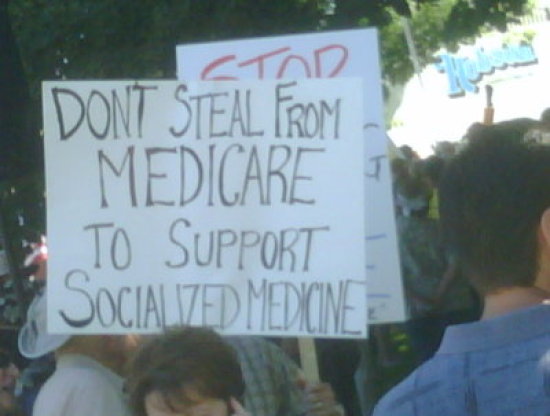
The notion of regulation as being on a sliding scale where "more is worse" was a manufactured American meme created by the Kochs in the 1980s. It emerged from some of their epic fights with the environmental protection agency and their subsequent lobbying and public relations outreach efforts that followed. They set up and funded number of institutions dedicated to telling this story (and others, including that one about hairdresser licensing). The Heritage Foundation, the American Enterprise Institute, and the Cato Institute to name a few.
If you think about it for a few seconds, dumbing down a complex system like laws or regulation to "more vs less" is quite stupid. It's like saying that some programmers believe in "more lines of code" and some believe in "fewer". Do you want more laws or fewer laws? The question doesn't make sense. You want the right kind of laws, right? Ones that are as simple as possible and no simpler. The same for code.
I think it's important to put this type of thing in a historical context though. These ideas and stories don't emerge out of nowhere - there is usually money behind them. In this case, it was money from an oil and chemicals company that had a singular goal - to fight the EPA - so it could destroy the natural environment in America with absolute impunity.