I saw a demo of Metro on a tablet at the Microsoft store a few weeks back and was really, really turned off. Why are the app squares of variable sizes? The guy accessed a settings menu out of nowhere. I was so confused I had to ask him to show me how he did it. There were no indications, cues, hints, etc, that would've led me to believe the menu was there. This isn't only limited to the settings menu.
I don't want to turn this into an iPod/iPad vs. WP8/Surface debate, but the first thing that popped into my head after I walked out of the store was "Jesus, my mom would have a hell of a time learning how to use that." She's a pro with her iPad, and it'd take her a very long time to reach that same level of savviness with a tablet running Metro.
Metro isn't designed for the average person. There's nothing that directs you, there are no consistent UI elements that carry on throughout the design. Every app the guy opened was designed differently. With iOS, I at least have the top (and often bottom) nav bar to guide me. I, a guy who's been playing with computers for years, was utterly confused and put off from Metro.
I think they've got a long way to go if they plan on seeing the same adoption of their WP8 phone that the iPhone has seen. I'm not sure if that's what they want, but I assume they do.
>"There were no indications, cues, hints, etc, that would've led me to believe the menu was there. This isn't only limited to the settings menu."
You're right. You're totally right. What I think you're missing though is that this is a pattern. And once you learn this pattern ONCE, it applies to EVERYTHING. That means that the settings for EVERY app are accessed the same exact way. Sharing from ANY app is accessed the same exact way. Etc.
This, I think, will be very powerful. Sure the charms menu is a little unintuitive at first (especially with a mouse) but once you figure it out, it makes your life much easier in the long run.
Good point. How do you access settings for an iOS app? Some are in the Settings app, under that app's name. Some are in the Settings app, under Notifications. Some are in a settings view within the app itself that's accessed by a gear icon somewhere on the screen.
In Facebook you go to the pop-out side menu, scroll to the bottom and find settings. In Twitter, you go to the Me tab, scroll to the bottom and find settings. In Foursquare you touch the Foursquare logo to show notifications then touch an icon with gears to get to settings.
It's interesting that this understanding exists. To note a few case: the Windows Phone was awarded the most intuitive phone, and another one that said it's the best phone for people over 50 (or 60?). Also user satisfaction is right up there with the iPhone.
What do you think about Android? Personally I find it confusing with menu lists in several places (apps, settings, etc.). The iPhone I agree is very intuitive. And I tend to think the WP is even simpler.
That is interesting because I really like the aesthetic. Some of the apps I have used are indeed not consistent but I found the same on iPhone and android as well.
Another thing I think to keep in mind as well is designing and implementing for a 'metro' UI is new for many developers and it will take time to get used to (and create) the conventions. I can't recall: when the iPhone came out was there a period of 'flailing' as devs figured out conventions that worked?
But I think that's because "like" and "aesthetic" wasn't quite the words the gp was aiming for.
It's more like their User Interface Paradigm just doesn't work.
A cool sports car with no door handles or keyhole, that the cool kids open with right twist of the wrist or something can have a really nice aesthetic but be really annoying in the real world. Multiply that by a thousand and you've got something where the right mindset will get you love while the rest of us will hate and hate. Especially, menus in invisible places. That's a terrible designers are often tempted towards but should know better. If I ever have to use that stuff, some karma bolts be stinging the aestheticians who dreamed them up.
I have news. The average person is less, less - not more - less patient with "getting used to the conventions" than developers. The average person may wind-up using "conventions" but probably couldn't "describe conventions" more easily than they could solve differential equations.
If how you use the thing isn't screamingly obvious, how do you expect Joe Average to shell out the big bucks for something they still expect to be "mostly just a phone".
>I can't recall: when the iPhone came out was there a period of 'flailing' as devs figured out conventions that worked?
When the iPhone came out you couldn't develop apps for it.
There was a period of time when everyone was just using the Apple supplied apps and they laid the groundwork for establishing nearly all the conventions. New conventions have since been established (ie. pull-to-refresh) but the 'tone' was solidly set by Apple.
I like the idea of tiles but as they get more numerous and varied (with photos and custom apps) it starts to look like the classified ads. I don't know where to look and feel disoriented.
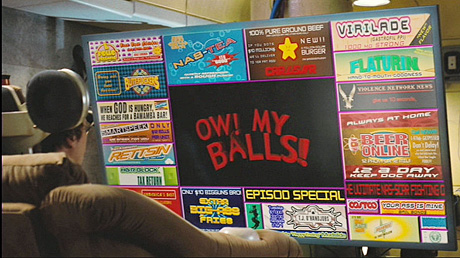
Yes. The white on solid color tiles look good with a couple of colors on the screen but once there are 8 animated tiles in different colors and background images on the screen, it looks more like the TV ads on Idiocracy: http://creativebits.org/files/idiocracy-tv.jpg
How is this different than the iPhone or Android metaphors? There you have a bunch of tiles that are all the same size. Is that more confusing than different sizes?
Integrated Internet calling: In Windows Phone 8, developers can create VoIP apps that plug into our existing calling feature so Internet calls can be answered like traditional phone calls, using the same calling interface.
Device encryption: To help keep everything from documents to passwords safe, Windows Phone 8 includes built-in technology to encrypt the entire device, including the operating system and data files.
Windows Phone 8 updates will be delivered wirelessly over-the-air, so you don’t have to bother plugging your phone into your PC to update anymore. Second, we will support devices with updates for at least 18 months from device launch.
I hope full-device encryption is a feature that will be soon supported on iOS (currently it only encrypts email, contacts and app data that uses the API).
My understanding is that the entire storage device is transparently encrypted/decrypted on the iPhone 3GS and up. Unfortunately all this means is that if someone pulls your phone apart they can't pull the data, but if they jailbreak it they can. If your phone is PIN-locked, you're secure.
This is why 'erase all content and settings' takes only a few seconds on newer devices, vs. hours on the iPhone and iPhone 3G - all it has to do is erase the decryption key and the entire partition is effectively garbage.
That's not what this Apple KB cites [1]:
"This provides an additional layer of protection for your email messages and attachments. Third-party applications can use the data protection APIs in iOS 4 and later to further protect application data."
That does not imply all data is encrypted - in fact, it implies it requires app-level support and not even all first-party app data is encrypted.
There are at least two different kinds of encryption at work on Apple mobile products. The one that this knowledge base is discussing, is a crypto accelerator framework that allows you to quickly do high-quality encryption on a segment of data.
However there is also fundamental encryption placed on the solid-state flash assembly that drives all iOS devices. It is not user accessible, it does not rely on user visible passwords, and guarantees that when the device is off, the filesystem cannot be read.
The first generation of Windows 7 devices did not offer hardware file system encryption, ironically keeping them from connecting to most Microsoft exchange installations.
I think the bigger news is that it is going to share the core with Windows 8/RT which will allow developers to target phone, tablet and PC at the same time.
Yes I think this is a big news. Developers were afraid to commit to windows phone as a platform citing low installed base. Now with ability to target PC and tablet's suddenly the reach of your app explodes.
I have to say I just switched over a Windows 7 phone (more out of curiosity than anything else) and although there are a lot of features I like, there are an equal number I dislike. The attempt by MS to completely shut out Google is annoying. In many respects, I really feel at times I'm being forced into using MS products.
All in all, I give the Win7 phone a 4 on a scale of 1-10. With the continuation of the Metro interface, the forcing of MS products and lack of alternatives (like Opera or FF browser instead of IE) in the Market place, I doubt the Win8 phone is going to be a substantially better product.
Well, you can only sync one gmail account (without buying an app which allows more) so having multiple gmail accounts means I had to forward one of my emails to a hotmail account and haven't been able to sync my other google calendar with my handset. The other program I use a lot is google music. I tried the CloudMuszik to get around this and it was horrible so I actually tried the desktop Zune interface. Again, another horrible experience. It brought my desktop PC to a crawl and would lock up and crash constantly.
Without fully committing to paying for a bunch of apps to get my stuff working, it just seems like a pain if you're hooked into using a lot of google's apps. Granted, if I was going to stay, I would invest in the apps, but I'm not quite there yet.
Just for the record, I'm using the HTC Trophy on Verizon - which is on their 3G network.
Also, if there's something I'm missing, let me know. I'm all for having a more trouble free experience with the phone.
18 months guaranteed updates? If you're not going to guarantee Apple-like longevity why would you even do it, period? I'm sure MS would like to get that level of support but if they don't want to bet on it why not just have everyone live in ignorance?
18 months is a hell of a lot better than the 0 months you get with many android-based devices (or, effectively, negative months with 2.1 released devices).
Why would average person want a major OS upgrade for their phone? I can understand a minor update (Bug fix etc). But do I really want my Phone OS to be updated (yes as a developer but no as a user)?
When 'new' features are advertised, many people like to use them.
"You can do XYZ on your Android, except not the one you bought brand new last month because it's really 23 months old already. To use XYZ, you'll need to shell out another $x00 vs just getting a software download".
Google allowing device manufacturers to even have a hand in deciding who gets updates and when is... crazy. The damage that can and will do to the Android brand over time is immense. The biggest 'value' most people see in Android is "not Apple", which isn't really a long term viable competitive position to take. MS has (and has had for some time) an opp to eat away at the "anything but apple" smartphone crowd, and they'll be taking share away from Android.
With similar difficulties that Android has - ie, the handset manufacturers being part of the update process - another question is, how long after an OS update is posted will it take to see it on all devices?
Will some arrive in days or weeks, while others linger for months? Will Nokia be given preferential treatment?
New phones? So WP7 ones are not upgradable then... I think this is yet again bad news for Nokia, as it deepens their situation of everyone knowing the devices they are selling are soon going to be obsolete.
Many device makers seem to have no problem selling Android 2.1, 2.2 and 2.3 phones that have no chance in hell of ever getting upgraded. Not sure why that would be much of an issue for Nokia, although, personally, I'd like to see MS enforce upgrades from manufacturers vs allowing a 'wild-west' Android-style ecosystem.
However, enthusiasts will have the ability to opt out of the carrier restrictions—likely with some kind of "this will void your warranty" disclaimer, as their phone will probably cease to be eligible for carrier-provided tech support—and manually install updates as they become available.
Yes, that shows MS is actually quite hostile to hardware vendors. There is no need to complete drop support on existing hardwares, you can at least provide a lite version if the old hardware (actually not that old) isn't powerful enough.
This isn't really hostile to hardware vendors if you think about their incentives. They're the parties who would benefit most from a user buying a brand new phone once the 18 months of support expires. There's zero incentive for most hardware vendors to support old hardware with software updates, because unlike Apple, they don't see any additional revenue once the phone is in the customer's hands. Apple even gets revenue from customers of second-hand iPhones years after initial release, thanks to their cut of the app store sales.
I don't know what is with the comments on tech sites, but I just read this story on Slashdot and the summary was misleading and omitted Windows Phone 7.8 completely. There were a whole bunch of comments like yours and many were modded up.
And not one comment pointing out the existence of version 7.8 was modded up. It's like the crowd wants Nokia to fail and wants to ignore the real news or something.
So at least that post makes 7.8 appear like nothing but a minor skin upgrade. Why is that interesting in any way? Any poor buyer of current Lumia phones is still never getting an upgrade that fills in all those gaping holes in the feature set.
Of course nobody expects that the existing phones will magically grow new hardware :-) But there are plenty of software-only features like native code applications, better multitasking, sensible VoIP support, or a more modern browser. Some of these are filling in really major gaps.
Also if the current phones can't be upgraded, it seems virtually guaranteed that Nokia will continue to release new low end devices running WP7 for a long time. This means that those phones couldn't e.g. support NFC, and would be rather unappealing devices if NFC finally takes off.
I bought Lumia 900 the day it was released and no, I don't feel it's a "dead-end phone". Given that Microsoft backports many of software features of WP8 to WP7.8 (which BTW was under big question in Lumia 900 launch time frame), I'm even less inclined to think so. Will I be getting WP8 device any time soon, just because it's there? I don't think so - I'm pretty happy with my phone.
Native applications will not be making it to the Lumia 900 and as such your going to start seeing more and more apps (and especially games), not be able to run on the phone.
This is different in that it's nothing to do with hardware. A super simple contrived example would be if someone builds a calculator using c++, you can't install it even though there is no hardware reason that you couldn't
Look, no matter what phone or OS is, there will be something that you won't be able to run unless you want to update every piece of hardware/software every few months. There's always a trade-off if you are not trying to be "current" at all costs. It's OK, there're more important things in life than an ability to run a piece of software on the phone.
How many WP8 features will be eventually backported? Will there be a 7.9? 7.10?
It's a current phone, much like my Macbook is a fairly current (as in "non-vintage") Lion-running Mac. Like my Macbook, it won't run the next major version. The difference is that my Macbook is 6 years old.
I really like the "tiles" concept for touch screens. After years of not using any MS product, I may actually use Windows again.
Only that MS should have called it "Tiles" and continued Windows as a different product line for desktop PCs. PCs will no go away any time soon, because touch screens are not (yet) good for office work.
MS seems to be pretty much betting their company on their company on the metro interface and their win RT core. I'm curious about how well this core scales to low power devices. What's also important is the migration path from win32 to winRT. Apple has brought most of the backend frameworks from OSX to iOS, which makes porting powerful mac applications easy. Does anyone develop on winRT already?
I am working on a game in C#. I wrote the game originally for WinRT using a "Portable Class Library" for 80-90% of the code. Over the weekend I ported the game to Windows 7 and XNA re-using the portable class library without modification. Naturally the user interface needed to be rewritten but I think that's for the best.
I've built a few cross-platform apps that work both on WP7 and Win8 - as noted before, Portable Class Libraries is a huge help. My web services were fully reused as were all of my base libraries, just had to redo the UI - and between Silverlight and WinRT I was able to copy and paste a lot of my XAML (just a few namespace changes and a couple of minor mods).
I actually did a talk at a user group where I showed a few different apps, then translated them live between the phone, the web, and the tablet.
Thanks for the input. So you can do cross platform if you use these portable class libraries from start. How about about porting win32 code from the .net era? I would guess that most of today's windows applications are running on those libraries, don't they?
I either use a PCL from the start, or I've taken existing code and moved it into the pCL (there are a few tricks to get around due to pieces missing from the various libraries, since they are an overlapping subset).
So if you have existing .net code, I'd try to plug it into the PCL and see which namespaces, etc. are missing then work backwards from there - even if you can only get some of your code, it's a better start than copy/pasting everything IMO.
It's great that they are trying something different from iOS and Android, but I can't help thinking that most of the icons on those home screens look very similar. They seem to be mostly either a white icon on a plain square, or a photo. A bit of colour variation on the icons might make navigation a but faster.
On Safari, the whole top left corner is blocked by a sticky "floating" youtube video. The video can't be played or closed. All clicks fall through to the page elements under the video.
"Internet Explorer 10: The next version of Windows Phone comes with the same web browsing engine that’s headed for Window 8 PCs and tablets..."
Not to sound trollish, but is that really a feature?
It didnt used to be the case and it can be reassuring to users that they are getting a decent quality browser and not a hack. Especially for users coming off the Blackberry and Symbian platforms. So, I think its fair to say.
Maybe it's just me, but I liked the simplicity of the Windows Phone 7 start menu. I hope that's not compromised in the new start menu - it looks a little busy.
I didn't even know Phone 7 was fully released. I hope Windows Phone 8 has a Professional-Home-Often-On-The-PATH-Train Edition-for-Workgroups. I couldn't live without that.



I saw a demo of Metro on a tablet at the Microsoft store a few weeks back and was really, really turned off. Why are the app squares of variable sizes? The guy accessed a settings menu out of nowhere. I was so confused I had to ask him to show me how he did it. There were no indications, cues, hints, etc, that would've led me to believe the menu was there. This isn't only limited to the settings menu.
I don't want to turn this into an iPod/iPad vs. WP8/Surface debate, but the first thing that popped into my head after I walked out of the store was "Jesus, my mom would have a hell of a time learning how to use that." She's a pro with her iPad, and it'd take her a very long time to reach that same level of savviness with a tablet running Metro.
Metro isn't designed for the average person. There's nothing that directs you, there are no consistent UI elements that carry on throughout the design. Every app the guy opened was designed differently. With iOS, I at least have the top (and often bottom) nav bar to guide me. I, a guy who's been playing with computers for years, was utterly confused and put off from Metro.
I think they've got a long way to go if they plan on seeing the same adoption of their WP8 phone that the iPhone has seen. I'm not sure if that's what they want, but I assume they do.